Saturday, June 2, 2012

A Kettle Of Condors

After our adventures in Pismo Beach, Betsy and I headed up the coast on our way to San Francisco for a meeting with my publisher.  Along the way we always keep an eye out for California Condors, though we've never had any luck.  Here's Betsy enjoying the scenery and "looking for condors."


A little way further up the coast we pulled off at the following look-out.  The scenery was beautiful, and we thought this would be a good place to get out and stretch our legs.


As soon as I got out of the car and took this picture, Betsy says "Hey Jim, take a look at this bird.  Is it a condor?"  I looked at it and said, "Oh yeah, that's a condor all right."  Here's what we saw:


We were excited to see our first condor.  Then Betsy said, "There's another one."  Sure enough, two were flying together.


Soon we noticed more and more of them, until finally they had formed a "kettle," just like hawks or vultures.  (The term kettle comes from the fact that the group of soaring birds look like they are circling within the confines of a kettle.)  Here is the kettle of eight condors.  A ninth condor was also there, soaring by itself.


We showed the condors to several people at the lookout, serving as field guides, and giving them views through our scope and binoculars.

One woman was almost beside herself with excitement.  She said she lived in the area and had looked for condors at this location for the past 15 years, but never saw any.  She had gone to the pinnacles before dawn trying to see them at their nesting grounds, but with no luck.  She had seen only one previous to this, and couldn't believe that we were able to view a large group like this.  In fact, we were looking at roughly 10 percent of the world's population of California Condors.

To document our sighting of condors, Betsy posed with the California Condor page in our Sibley field guide:


Here are a couple of video clips of the condors soaring, shot at maximum zoom with a point-and-shoot camera.  The picture is jittery, but at least it gives some sense of what it was like to watch them flying and interacting with one another.  In the second clip, notice the "wing dipping," which is characteristic of condor flight.


Friday, June 1, 2012

The Swallows of Arroyo Grande

After seeing Cliff Swallows gathering mud to build nests in Tuba City, Arizona, it was surprising to see the next step in the process in Arroyo Grande, on the California coast.  Here are a few pictures from our hotel, where a good-sized colony of Cliff Swallows was busy building nests under the eaves of the roof.  In the photos below you can see the fresh mud (darker in color) being added to the nest, as well as one complete nest to see what the final product looks like.

A Cliff Swallow works on its nest.

Cliff Swallows have cream-colored foreheads and buffy rumps.

Adding fresh mud to the early stages of a nest.

Tight living quarters.

Finished product.

The Great Pismo Lagoon

After our visit to Tuba City we drove across the Mohave Desert to Barstow.  It was 108 ˚F in the desert, but only in the high nineties in Barstow when we arrived there in the evening.  I doubt we'll experience triple digits again for awhile.

After Barstow we went to the Pismo Beach/Arroyo Grande area on the California coast.  Very nice, with temperatures in the 70s.

We went birding at the Pismo Beach State Park Lagoon.  It was quite windy that day, but we were sheltered from the wind at the lagoon.  Still, we could hear the roar of the ocean waves the whole time.  Here's what the lagoon looks like:


We had a good time here, and saw many "California" species, including the California Gull, California Towhee, and California Darner.  Here are a few more sights from the lagoon:

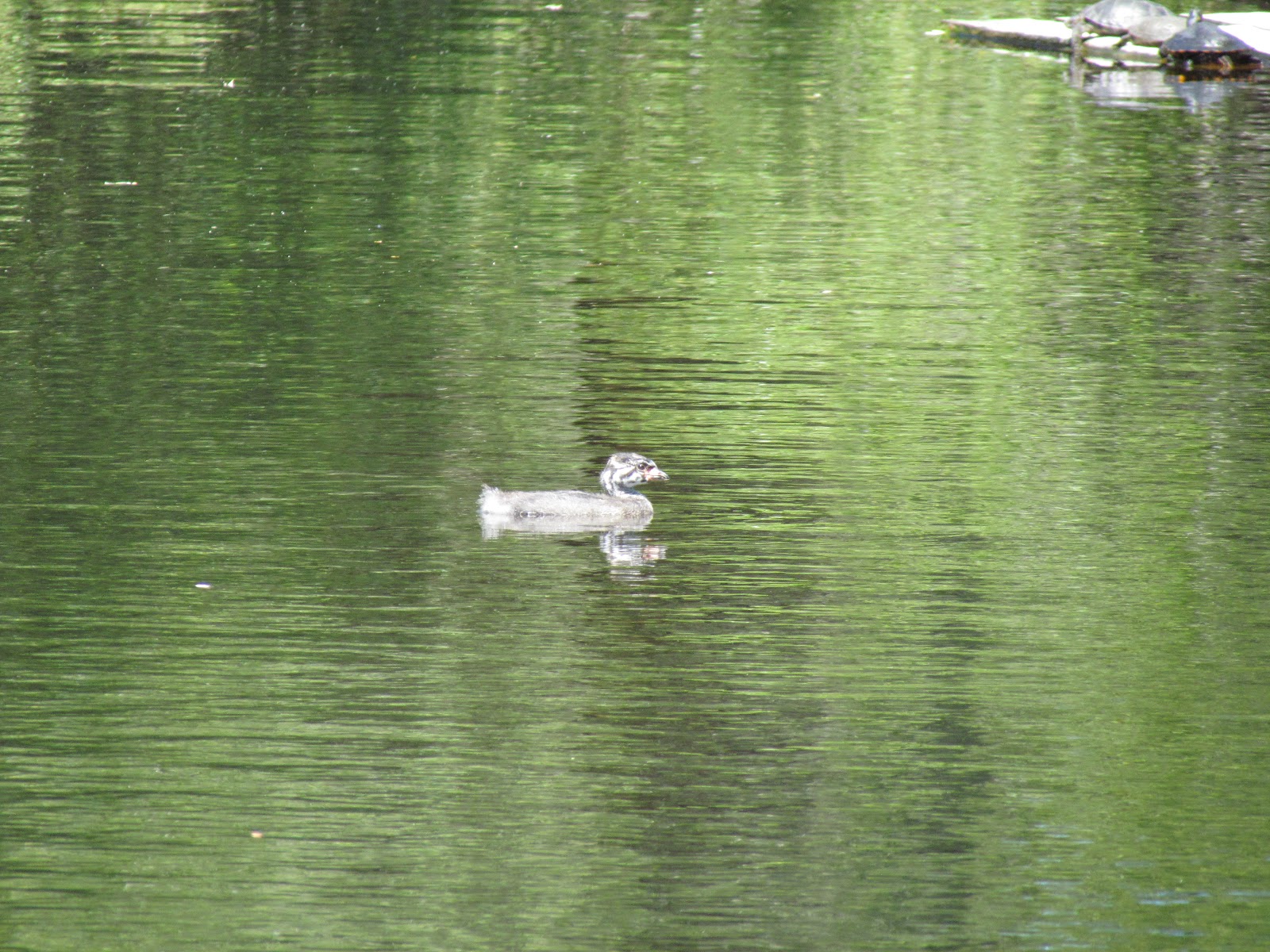
A young Pied-billed Grebe.

A male California Darner perched low in the grass.  Notice simple appendages, and lack of frontal stripes on thorax.

A male Blue-eyed Darner.

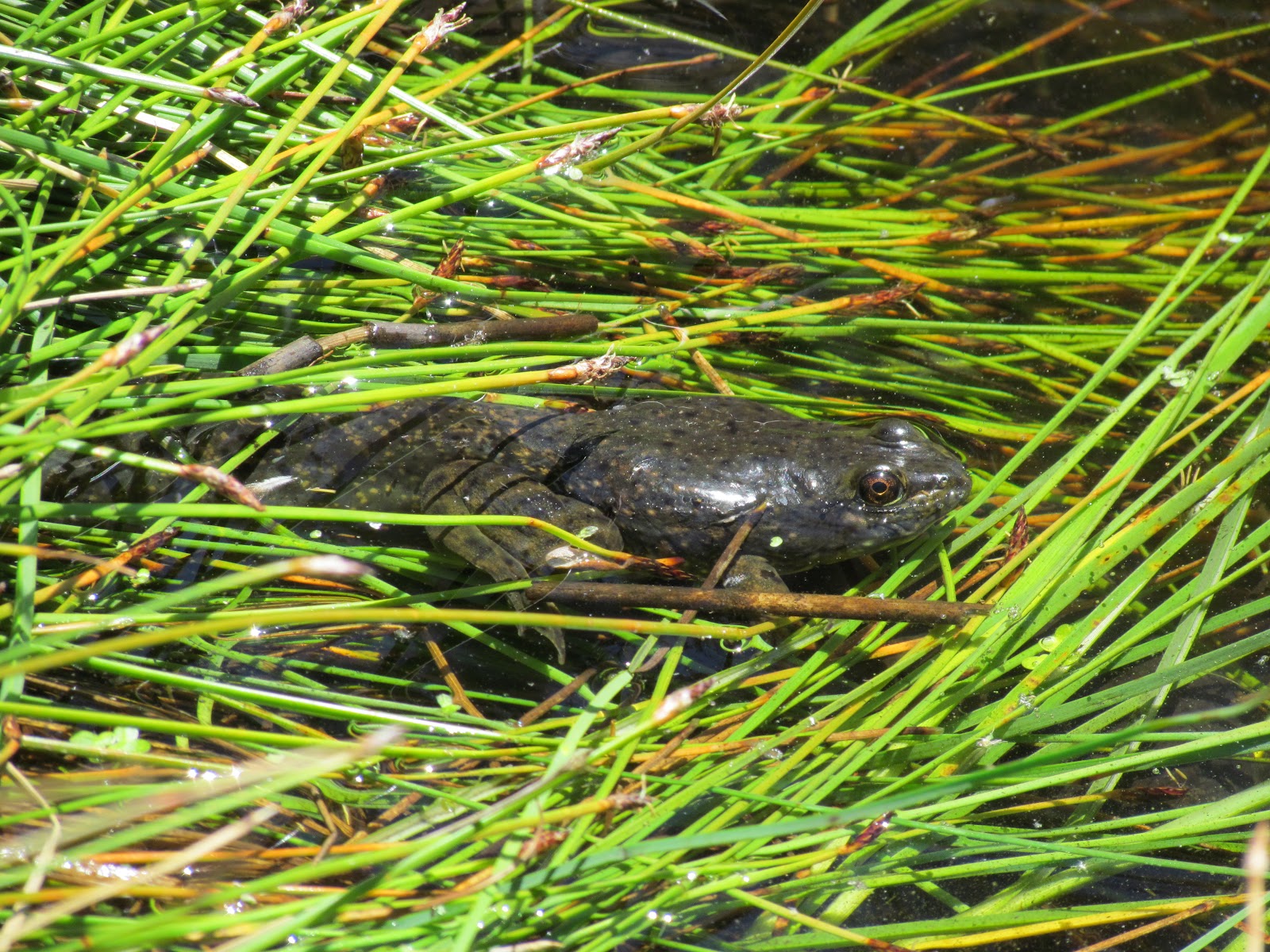
Bullfrog meditating on the lagoon's edge.

A young frog, still retaining its tail.

Wednesday, May 23, 2012

The Swallows Of Pasture Creek

Before leaving Tuba City, Betsy and I visited Pasture Creek Reservoir.  It's a very nice little lake, with lots of wildlife.  Here's what it looks like:

Nice habitat!


When we arrived, we saw a group of Cliff Swallows gathering mud for their nests.  Note the light colored forehead and buffy rump that distinguishes Cliff Swallows from others:


The swallows were building their nests on the nearby cliffs.  Check out that unconformity.


Some good dragonfly activity there as well, including Common Green Darner, Blue-eyed Darner, Variegated Meadowhawk, and Wandering Glider.  No Desert Whitetails, though.

Lots and lots of damselflies, too.  As we were leaving we saw a teneral (freshly emerged individual) take flight.  Another damselfly grabbed it and took it to a nearby bush to eat it.  It's a damsel-eat-damsel world out there.


Monday, May 21, 2012

The Adventure of the Tuba City Treat

Betsy and I went to Tuba City yesterday.  We stayed at a nice, new Inn on the Navajo Reservation run by the Hopi Indians.  It was quite a nice play to stay.

Moenkopi Legacy Inn – We had breakfast out by the pool this morning, it was delightful.

A nice little manmade stream and pool in the courtyard area.


Betsy investigating a model Hopi dwelling.  Very nice.

A sample of the Hopi art in the lobby.

Though the Inn was treat enough, the real treat for us was the chance to observe the annular eclipse of the Sun.  I set up my spotting scope to project an image of the Sun on a poster board, and used the backdoor of the Rav 4 to put the poster board in the shade.  The results were quite good.  This was the first complete annular eclipse that we had observed.

The beginning phases of the eclipse.  Notice the two prominent groups of sunspots.

The top group of sunspots is disappearing behind the Moon.

Deep into the initial phase of the eclipse now, with both groups of sunspots covered.

The beginning of the annular phase of the eclipse.

A nice full ring of fire.  About this time we experienced a noticeable chill in the air due to reduction of sunlight.

Annular eclipse of the Sun.

The Moon is moving away from the Sun now, and the top group of sunspots is coming into view again.

Observing an eclipse.

An intrepid eclipse chaser.

You may recall that two weeks ago we had a "super moon," due to the full moon coinciding with perigee, the closest approach to the Earth.  As a result, this new moon is at apogee, the farthest distance from the Earth, which makes it appear smaller.  That's why the eclipse is annular as opposed to total – the Moon is too small at apogee to completely cover the Sun.

Oh, one more experience awaited us after the eclipse was over.  We went to the Hogan Restaurant here in town and had a delicious Navajo Taco.  Definitely a Tuba City Treat!

Thursday, May 17, 2012

The Case Of The Speaking Whisperer

I gave a dragonfly talk recently at the Boyce Thompson Arboretum.  It was well received.  Here are a couple of the ads that our good friend Paul Wolterbeek put out to publicize the talk.


The Case of the Shoveler

One of the many beautiful birds that make Leisure World their home, for at least part of every year, is the Northern Shoveler.  The individual below is a male shoveler.  One look at his bill shows how he got its name.